
Since our shelter-in-place orders in March and continued time at home, I’ve been trying to take this opportunity away from on-site work to learn a bit more about myself and my family and the way that we interact with each other, particularly during a time when leaving the house is highly restricted. This forced closeness has given all of us a chance to do some soul-searching.
One thing that is meaningful to me right now is learning more about how different personality types react in times like these, living in close quarters. Being at home with several people on a seemingly unending loop takes a lot of patience, and distinct personality types respond in very different ways to being alone or being in groups. I am currently sheltering at home with three other people and two dogs in a relatively small space. As I type this, my daughter is sitting next to me, my son is still asleep (so we’re all having to tip-toe around) and my partner Tony is on a conference call with his work in the front room (again, we all have to be quiet because of that). At the root of being able to cohabitate with multiple people is the ability to understand each person’s personality type: are you an introvert or an extrovert?
Most people think that the terms “introvert” and “extrovert” refer to how outgoing a person is, and that’s only partly true. Introverts are not necessarily shy, and extroverts aren’t necessarily comfortable entertaining people. What these terms do show us is how we recharge, what we do when our mental resources are depleted. If you are an introvert, you recharge your batteries by being alone. For example, I am an introvert. When I am operating on full-steam, I can entertain a whole room full of people with no problem at all. I have performed onstage in front of thousands of people; I have taught classes and led discussions with 30+ people on Zoom without a problem. When I feel stressed out, though, I need to be by myself with no connection to others: no phone calls, no face-to-face, no texts. I need to be quiet by myself for a bit, then I’ll recharge and be able to interact comfortably with people again. This whole social distancing thing would be perfect for me IF I were alone in my house. But I’m not, so it is a definite challenge for me to stay sane and patient because…
…there are others in my family who are extroverts. Unlike me, they need to be around people to recharge their batteries. So when an extrovert is feeling mentally drained, they need to engage with other people to recharge. This can be a problem in a time of social distancing.
Extroverts need connection and activity to feel better when they are emotionally drained; introverts need to be alone and quiet.
It’s very important to find out how those in your family recharge their mental batteries. It can save a lot of stress to know that when your child or partner is feeling anxious, he/she might be an introvert and need time alone instead of forced time with the family. Or your child/partner might need to engage with other people in the family to get back on track if he/she is an extrovert. When an introverted person is stressed or drained, trying to pull them into the family group may prove very challenging and cause tempers to rise. Conversely, an extrovert may be trying to continually engage you if they are stressed when you are trying to work or relax, again causing some tension.
Introverts and extroverts can get along in close quarters if we take time to learn about how each personality type responds to stress.
Here is a great article to help you determine if somone in your life is an introvert or an extrovert:
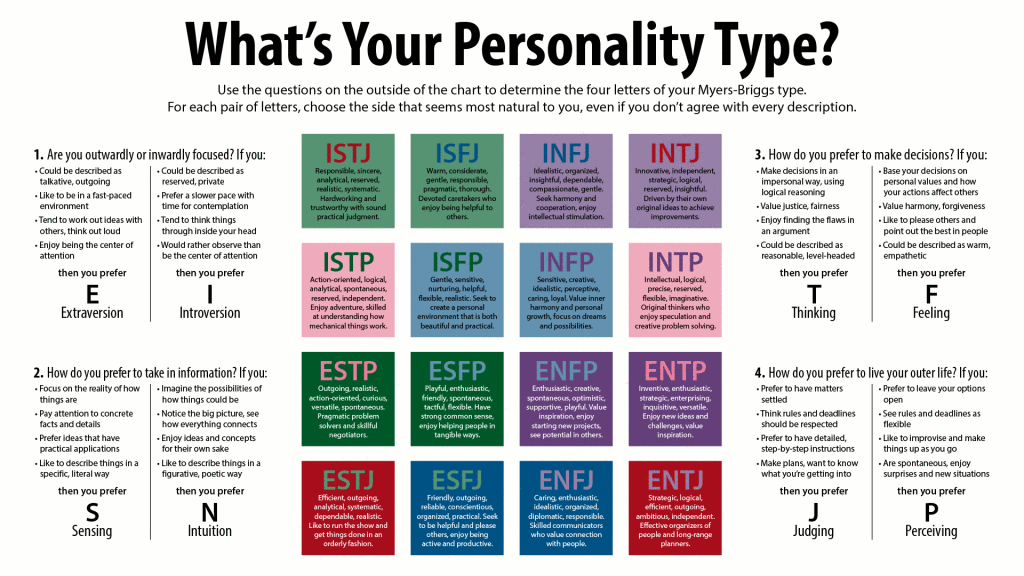
Research on personality types and how they affect relationships began with something you may have heard of before, the Myers-Briggs Type Indicator (MBTI). Based on previous studies by psychiatrist Carl Jung, the MBTI is a surprisingly accurate indicator of how you experience the world, based on four principal psychological functions – sensation, intuition, feeling, and thinking. I took my first MBTI in the late 1980s, and, after taking the same test today, I still came out with the same result as I did over 30 years ago!
Here is a link to a quick version of a personality test if you’d like to try it yourself (it’s free and no need to log in!):
https://www.16personalities.com/
And more information about personality types:
 Amanda Sullivan, Maed, lcmhc